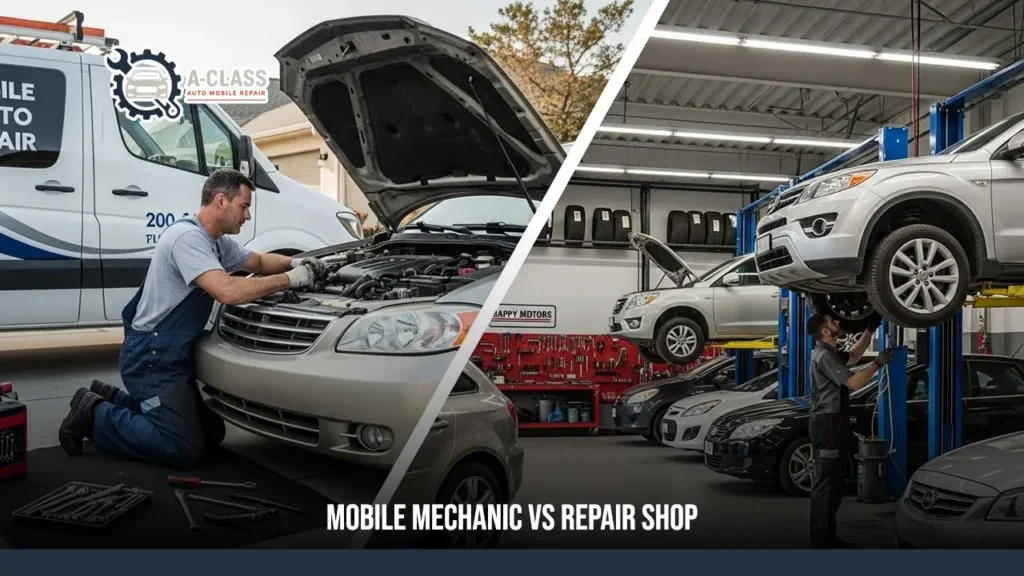
Choosing between a mobile mechanic and a traditional repair shop affects your time, budget, and overall experience; At A-Class Auto Repair, we specialize in professional mobile car repair service throughout Houston, bringing certified expertise directly to your location without the hassle of towing or waiting rooms.
Mobile Mechanic vs Repair Shop
Both options have legitimate strengths, and understanding these differences helps you make informed decisions that save time and money while ensuring quality work.
- Mobile mechanics operate from fully-equipped service vehicles, traveling to your home, office, or roadside location to perform repairs and maintenance on-site.
- Traditional repair shops maintain fixed facilities with lifts, specialized equipment, and multiple service bays where you bring your vehicle for work.
Neither option is universally superior, as the right choice depends on the repair complexity, your schedule constraints, location convenience, and whether the job requires infrastructure only available in shop settings; Most drivers benefit from knowing when each option serves them best, using mobile services for routine maintenance and accessibility, while reserving shop visits for complex repairs requiring heavy equipment or extensive diagnostic capabilities.
What Is the Difference Between a Mobile Mechanic and a Repair Shop?
The fundamental differences between these service models extend beyond location, affecting how service is delivered, what equipment is available, and how the entire customer experience unfolds.
Service Location and Accessibility
Mobile mechanics eliminate the need to transport your vehicle anywhere. They arrive at your specified location with tools, parts, and diagnostic equipment, transforming your driveway, parking space, or roadside into a temporary workshop.
Equipment and Infrastructure
Traditional shops house specialized equipment that cannot travel: hydraulic lifts capable of raising entire vehicles, wheel alignment machines, paint booths, transmission jacks, and advanced diagnostic systems connected to manufacturer databases.
Service Scope and Specialization
Shops typically handle the complete spectrum of automotive work, from simple oil changes to engine rebuilds and body work; Mobile mechanics focus on services that can be completed efficiently without permanent infrastructure: brake repairs, battery replacement, spark plug replacement, tune-ups, fluid services, and diagnostic work.
Operational Model
Shops maintain fixed overhead costs including building leases, utility bills, and multiple service bays, often requiring higher labor rates to cover these expenses. Mobile operations have lower overhead, potentially offering more competitive pricing for services within their capability range.
Convenience and Time Comparison
Time efficiency and convenience represent major factors in the mobile mechanic vs repair shop decision, particularly for busy professionals and families juggling multiple responsibilities.
Scheduling Flexibility
- Mobile mechanics often provide same-day service and work around your schedule, arriving at times that minimize disruption to your routine.
- Traditional shops operate on their schedule, requiring you to drop off your vehicle during business hours and pick it up when service is complete.
Transportation Logistics
When using a repair shop, you must arrange how to leave your car and get yourself home or to work, and this might involve asking family for rides, using rideshare services, or renting a vehicle, all adding time and cost to the service experience; Mobile mechanics eliminate this entirely since you’re never separated from your vehicle.
Wait Time Elimination
Shop visits often involve waiting rooms, even for quick services like oil changes. Mobile service means you continue with your day, working from home, handling household tasks, or simply relaxing, while your vehicle receives professional attention steps away.
Real-World Time Comparison
Consider a brake pad replacement requiring two hours of labor:
- Traditional Shop: 30 minutes driving to shop, 2 hours wait or arranging alternative transport, 30 minutes return trip, plus coordination time = 3+ hours of disrupted schedule
- Mobile mechanic near me: Technician arrives, completes work while you remain productive at your location = 2 hours with zero schedule disruption
Equipment and Repair Capabilities
Understanding equipment differences clarifies which repairs suit mobile service versus requiring shop infrastructure, helping you make appropriate choices based on your vehicle’s needs.
Mobile Mechanic Capabilities
Professional mobile mechanic in Houston arrives equipped to handle extensive repair categories:
Diagnostic and Testing Equipment
- Professional OBD-II scanners for reading trouble codes
- Battery load testers and charging system analyzers
- Multimeters for electrical diagnostics
- Compression testers for engine health assessment
Essential Repair Tools
- Hydraulic floor jacks and jack stands rated for vehicle weight
- Complete socket and wrench sets including specialty tools
- Impact wrenches powered by portable generators or battery packs
- Brake bleeding equipment and fluid exchange systems
- Torque wrenches calibrated for precise specifications
Common Services Performed Mobile
- Complete brake system service including pad and rotor replacement
- Battery testing, charging, and replacement
- Spark plug replacement and ignition system work
- Oil changes with filter replacement
- Fluid flushes and replacements
- Gasket reseal for minor leak repairs
- Serpentine belt and hose replacements
- Starter and alternator replacement
- Pre-purchase inspections for used vehicles
- Regular vehicle maintenance and tune-ups
Repair Shop Advantages
Charging system repair shop possess infrastructure impossible to mobilize:
- Multi-ton hydraulic lifts providing full undercarriage access
- Computerized wheel alignment systems measuring precise angles
- Transmission jacks and engine hoists for major component removal
- Paint booths with controlled temperature and ventilation
- Specialized manufacturer diagnostic systems
- Air conditioning service equipment for refrigerant handling
- Frame straightening machines for collision repair
- Multiple service bays allowing simultaneous work on complex projects
Need a fast and reliable mobile mechanic in Houston Texas? A-Class Auto offers 24/7 mobile auto repair with 47+ expert mechanics & 8+ years of experience. Call now!
Call NowCost Transparency and Pricing Differences
Pricing structures and transparency differ between mobile mechanics and traditional shops, affecting your total cost and confidence in the service you’re receiving.
Mobile Mechanic Pricing Model
Mobile services typically offer straightforward, upfront pricing. At A-Class Auto Repair, we provide clear estimates before beginning work, including parts cost, labor charges, and any service fees. Our lower overhead compared to brick-and-mortar shops often translates to competitive rates for services within our scope.
You receive itemized invoices detailing exactly what you’re paying for, with warranty information for both parts and labor clearly stated. Multiple payment options—including credit cards, digital payments, and traditional checks—make transactions convenient.
Traditional Shop Pricing
Shops quote labor rates that must cover building expenses, utilities, equipment financing, and multiple staff members. While these rates may be higher per hour, shops can leverage efficiency from specialized equipment.
Hidden Cost Considerations
When comparing mobile mechanic vs repair shop costs, factor in indirect expenses:
- Towing fees: $75-$200 to transport a non-running vehicle to a shop
- Alternative transportation: Rideshare, rental cars, or lost productivity
- Time value: Hours spent coordinating shop visits versus working productively
- Convenience premium: Some situations justify paying slightly more for dramatically better convenience
For routine services like oil changes, brake work, and maintenance, mobile mechanics frequently cost less overall when accounting for total expenses and time savings.
Quality of Work and Expertise
Concerns about quality and expertise influence many drivers weighing mobile mechanic vs repair shop options.
Professional Certification and Training
Quality mechanic shop in Houston, like our team at A-Class Auto Repair, hold the same ASE certifications and manufacturer training as shop technicians.
Certification demonstrates proven knowledge in specific automotive systems: brakes, electrical, engine performance, and more. These credentials don’t depend on whether the mechanic works mobile or in a shop.
Traditional shops may employ multiple technicians with varying specializations, allowing complex jobs to be divided among experts in different systems. Mobile mechanics typically possess broader generalist knowledge, handling diverse repairs independently.
Quality Control Measures
Established mobile services implement quality standards comparable to shops:
- Using OEM or premium aftermarket parts with manufacturer warranties
- Following service procedures matching industry standards
- Providing written warranties on parts and labor
- Maintaining liability insurance protecting customers
- Documenting work with detailed invoices and service records
Shops benefit from supervision structures where multiple technicians review complex work, though this advantage mainly applies to extensive repairs beyond mobile service scope anyway.
Real-World Performance
Quality ultimately reflects individual mechanic skill and professionalism rather than service model. Research both mobile mechanics and shops through customer reviews, certification verification, and warranty offerings.
At A-Class Auto Repair, our certified technicians bring years of hands-on experience across all major automotive brands, handling everything from routine maintenance to complex diagnostic challenges with consistently high standards.
Read More: top 10 low maintenance car brands
When a Mobile Mechanic Is the Better Choice
Certain situations make mobile service clearly superior, maximizing convenience while maintaining quality and reducing costs.
Routine Maintenance Schedules
When your vehicle needs regular oil changes, tune-ups, or scheduled inspections, mobile service eliminates the recurring hassle of shop visits.
Breakdown Situations
If your car won’t start or becomes undriveable, roadside assist from a mobile mechanic often resolves the issue faster than towing to a shop and waiting for service availability.
Time-Constrained Professionals
Mobile mechanics serve you at your office parking lot, allowing continuous productivity while your vehicle receives expert attention. This works exceptionally well for brake repairs, battery service, or spark plug replacement that can be completed during your workday.
When a Repair Shop Is the Better Option
Specific repair types and situations require shop infrastructure, making traditional facilities the appropriate choice despite convenience trade-offs.
Major Component Replacement
Transmission removal and replacement, engine overhauls, or other work requiring heavy components to be extracted from the vehicle needs shop equipment.
Frame and Alignment Work
Wheel alignment requires computerized equipment measuring precise angles and making minute adjustments, technology that cannot travel effectively; Similarly, frame straightening after collisions needs specialized machinery found only in shops with proper facilities.
Extensive Diagnostic Challenges
While mobile mechanics carry professional diagnostic scanners, shops may access manufacturer-specific systems providing deeper data access for complex electrical or computer-controlled system issues.
Climate-Controlled Requirements
Certain repairs perform better in controlled environments. Paint work needs specific temperatures and dust-free conditions. Air conditioning service requires specialized equipment for refrigerant handling that meets environmental regulations.
Multi-Day Major Repairs
Projects requiring days of work or extensive disassembly benefit from shop facilities where vehicles remain secure overnight with parts organized systematically. Complex engine rebuilds or major suspension overhauls fit this category.
Warranty Requirements
Some manufacturer warranties stipulate that certain repairs must occur at certified dealership facilities.
How to Decide Between a Mobile Mechanic and a Repair Shop
Making the right choice between mobile mechanic vs repair shop involves evaluating several factors specific to your situation and vehicle needs.
Assess the Repair Type
Start by understanding what your vehicle needs:
- Routine maintenance (oil changes, tune-ups, brake pads) = mobile mechanic excels
- Diagnostic work with clear symptoms = mobile mechanic handles effectively
- Complex repairs requiring heavy equipment = repair shop necessary
- Specialty work (alignments, transmissions, bodywork) = repair shop required
Consider Your Schedule and Location
Evaluate convenience factors:
- Can you easily transport your vehicle to a shop?
- Is your vehicle driveable, or would towing be required?
- Do you have time for shop visits and alternative transportation arrangements?
- Would mobile service during work hours or at home dramatically improve your situation?
Compare Actual Total Costs
Calculate complete expenses:
- Mobile mechanic quote + convenience value – towing costs avoided
- Shop quote + towing fees + transportation costs + time value
Often, mobile service costs less overall despite similar or slightly higher hourly rates.
Verify Qualifications and Trust
For either option, confirm:
- Proper business licensing and insurance
- Relevant certifications (ASE or manufacturer training)
- Clear warranty offerings in writing
- Positive customer reviews and reputation
- Transparent communication about pricing and procedures